Buying Jewelry at Auction: Hallmarks, Gem Reports and Signed Pieces
Some links on this page are affiliate links. If you buy through them, we may earn a commission at no extra cost to you. Read our Affiliate Disclosure.
Jewelry is one of the most approachable corners of the auction world. Alongside the headline Geneva and New York sales, regional salerooms and online auctions offer signed brooches, antique rings and plain gold chains every week, often at estimates well within reach of a private buyer. The catch is that a ring photographed on a velvet cushion tells you very little about what it is actually made of, what has been done to the stones, or whether the name on the clasp is genuine.
This guide walks through what to check before you bid on jewelry at auction: the metal, the stones, the maker, the condition and the real cost once fees are added. It is written for collectors and buyers of pieces to wear, not for anyone looking at jewelry as a way to make money.
Start with the catalogue wording
Jewelry departments use a precise vocabulary, and the difference between two phrases can be the difference between a signed piece and a pleasant copy. A few terms worth knowing:
- “Signed Cartier”, “signed Van Cleef & Arpels” and similar mean the piece bears the maker’s name. Specialists usually add whether it is also numbered and whether a maker’s mark is present.
- “By Cartier” or a piece listed under the maker’s name means, at Sotheby’s, that in the house’s qualified opinion the piece is by that jeweler, even if it is unsigned.
- “Mounted by” is used by some houses, including Sotheby’s, to mean that the gemstones were provided by the client commissioning the jewel and were not supplied by the named jeweler. Definitions vary, so read the conditions of sale.
- “In the style of” or “attributed to” signals a lower level of certainty. It is not a guarantee of origin.
- “Accompanied by” lists the reports, boxes or certificates that come with the lot. If a gem report is not listed, assume there isn’t one.
Check exactly what the authenticity warranty covers. At Christie’s, it is given only for the information shown in uppercase type in the first line of the catalogue description (the Heading), not for the rest of the entry. Sotheby’s describes statements on authorship, origin and condition as statements of opinion. Other houses use their own conditions.
The metal: hallmarks and fineness
Precious metal is the one part of a jewel you can often verify from the piece itself. Many countries require or offer independent hallmarking, and the marks tell you what the metal is and, sometimes, where and when it was tested.
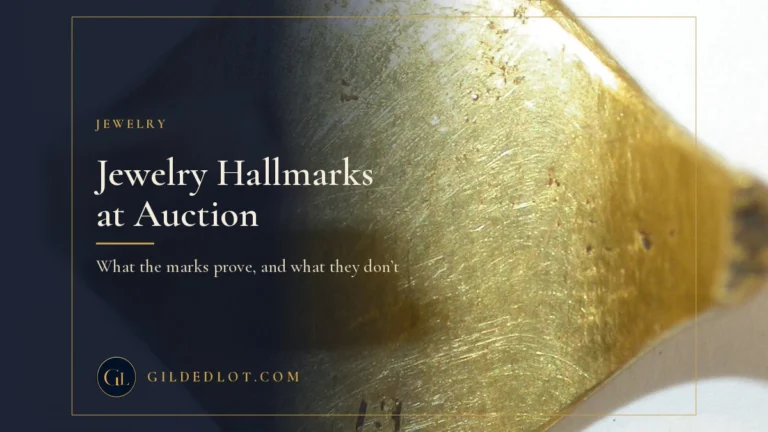
The modern standard is a fineness mark in parts per thousand. For gold, the common ones are 375 (9 carat), 585 (14 carat), 750 (18 carat) and 916.6 (22 carat). Sterling silver is 925, and 950 is one of the UK platinum standards, alongside 850, 900 and 999. In the United Kingdom, a full hallmark also includes a sponsor’s or maker’s mark and the mark of one of the four assay offices: London, Birmingham, Sheffield or Edinburgh. Pieces tested under the International Hallmarking Convention may carry the Common Control Mark, often shown as a pair of scales, which is recognised by the member countries of the Convention. Our guide to jewelry hallmarks at auction explains what those marks prove, and what they don’t.
Older and non-European pieces may be marked differently or not marked at all. A stamp such as “18K” applied by a maker is a claim rather than an independent test. If the lot description says the metal is “tested as” a given purity, that tells you the house checked it. If it simply says “yellow metal”, it has not committed itself, and you should price the lot with that in mind.
If you also collect bullion, our guide to buying gold and silver coins explains how fineness, premiums and EU VAT rules work for investment-grade metal, which is treated quite differently from jewelry.
The stones: what a gem report tells you
For diamonds and important coloured stones, an independent laboratory report is the closest thing to a passport. Reports you will often see at international sales include GIA for diamonds, and laboratories such as SSEF, Gübelin, GRS and AGL for coloured stones, though there are others.
Diamonds
A GIA diamond grading report records the carat weight, colour, clarity, cut grade (for a standard round brilliant), measurements and fluorescence, and the stone is tested as natural or laboratory-grown. A laser inscription of the report number on the girdle is optional on some report types. GIA offers an online Report Check, so you can confirm that the information on a report matches what is archived in GIA’s database. A report describes the stone at the time it was examined. If a stone has been chipped or recut since, the report no longer fits.
Coloured stones
For sapphires, rubies and emeralds, the two questions that matter most are origin and treatment. Sotheby’s jewellery notices state that rubies and sapphires have typically been heat treated, and that emeralds have typically been treated with oil or resin to improve colour and clarity. A laboratory report that records no indications of heating is therefore a material fact to read before you bid. Labs usually comment on the presence and extent of treatment, and Sotheby’s notes that they may differ in their assessment of a gemstone, including its origin. Some lots come with reports from more than one laboratory.
If a lot has no report and the stone is a significant part of the price, ask the department whether it has been tested. Commissioning a report yourself after the sale is possible, but by then you have already paid.
Condition: what to ask before you bid
Photographs flatter jewelry. Ask for a condition report on any piece you are serious about, and ask specific questions rather than “is it in good condition?”:
- Are any stones chipped, abraded, loose or replaced?
- Are the claws worn thin? Has the piece been re-tipped or repaired?
- Has a ring been resized? Signs of solder at the base of the shank usually show it.
- Does the clasp close securely, and are any safety catches working?
- What is the total weight, and the ring size or length?
Our guide on how to read an auction condition report explains how these reports work in general and why they are worth requesting even on modest lots. The same principle applies here: the report creates a written record of what you were told.
If you can attend the viewing, bring a 10x loupe. Look at the backs of settings, the hinges of bracelets and the edges of stones, where wear and repairs tend to hide.
Signed pieces and period jewelry
Signed jewelry from the great houses, and well-documented period pieces from the Georgian, Victorian, Art Nouveau and Art Deco eras, attract their own following. A few points to keep in mind:
- Signatures can be added. Check that the signature and any number are consistent with how that house marked pieces in that period, and ask whether the house has confirmed the piece.
- Originality matters to collectors. A brooch converted into a pendant, a later clasp or replaced stones can make a piece less appealing to collectors of that maker or period, even when it looks perfectly good to wear.
- Original boxes and certificates help, but are not proof on their own. Boxes are easy to reunite with the wrong jewel. The same logic applies to watches; our guide on how to authenticate a watch explains why papers and boxes are supporting evidence rather than proof.
- Altering a signed piece, for example resizing or re-setting, is best done by the maker or a specialist workshop, if at all.
Signed or unsigned? An honest comparison
Most buyers end up choosing between two kinds of lot: a piece signed by a recognised house, and an unsigned piece of similar materials and workmanship. Neither is the “right” choice. They suit different buyers, and the risks sit in different places.
| Signed piece from a known house | Unsigned piece of similar quality | |
|---|---|---|
| What you pay for | The materials and workmanship, plus the name, the design and the house’s archive. Part of the price is for the name. | Mainly the metal, the stones and the quality of the work. Little or nothing is added for a name. |
| How you check it | Signature, number and maker’s mark should match how that house marked pieces in that period. Some houses offer archive or certification services for their own pieces; ask what they cover and what they cost. | Hallmarks, testing statements and gem reports carry most of the weight. There is no archive to ask. |
| Main risk | Added or faked signatures, “married” parts, and replaced stones in a signed setting. The stakes are higher because the premium is higher. | Paying for quality that is not there: plated or low-carat metal described as “yellow metal”, or treated stones without a report. |
| Alterations | Resizing, re-setting or a new clasp can make the piece less appealing to collectors of that maker. Best left to the maker or a specialist workshop. | Usually much easier to resize, repair or adapt to your taste without affecting its appeal. |
| Later sale | The maker’s name is something a future buyer can search and compare, which makes the piece easier to describe. That is not a promise of any price. | Harder to compare like for like. Buyers tend to look at weight, stones and condition first. |
| Best for | Buyers who want a particular house or design and are willing to pay for it, and who will do the extra checks. | Buyers who want a well-made piece to wear, and who care more about the jewel than the name on it. |
A practical tip: before you bid on a signed piece, look up two or three comparable signed pieces sold recently and two or three unsigned pieces of similar weight and stones. The gap between those groups is roughly what you are paying for the name. If the name is not important to you, an unsigned lot of similar weight and stones may leave more of the same budget for the metal and the work.
Auction or retail jeweler?
The same honesty applies to where you buy. An auction gives you access to antique, period and secondhand pieces that shops rarely stock, and the price is set by the room. A retail jeweler sells at a fixed price, and as a business selling to a consumer it usually offers a returns policy and legal consumer protection that auction purchases often do not. At auction, the buyer’s premium, VAT and shipping come on top of the hammer price, and returns are normally limited to what the conditions of sale allow. If you need a specific new design, a certain ring size or a firm budget by a fixed date, a jeweler is often the calmer route. If you are hunting something unusual or older, auctions are hard to beat for choice.
Working out the real cost
The estimate is a guide to the hammer price, not to what you will pay. On top of the hammer come the buyer’s premium, VAT where it applies, and shipping and insurance. Some lots are marked in the catalogue as subject to import VAT because they came from outside the EU or UK. Our guide to the buyer’s premium sets out the current rates at Christie’s, Sotheby’s, Phillips and Bonhams, with a worked example.
Shipping jewelry is not trivial either. High-value pieces usually travel by specialist courier with insurance, and some houses will only release them in person or through an approved shipper. Ask before you bid, so the cost is in your budget rather than a surprise.
Where to look
The major jewelry sales in Geneva, New York and Hong Kong are listed in our Auction Calendar, with dates checked against each house’s own page. Below that level, regional salerooms and online auctions offer a steady flow of antique and secondhand pieces. Online marketplaces can be good hunting ground too, but the checks in this guide matter even more when you cannot see the piece in person and the description is written by the seller rather than a specialist.
See the upcoming jewelry sales
Frequently asked questions
Is a piece without hallmarks fake?
Not necessarily. Many antique pieces and items made in countries without compulsory hallmarking are unmarked. It simply means the metal has not been independently confirmed, so rely on the auction house’s testing statement or have it tested.
Can I trust a gem report that comes with the lot?
A report from a recognised laboratory is a strong starting point, but check that its number and details match the stone, ideally through the lab’s own online check, and note the date it was issued.
Do auction estimates for jewelry include the buyer’s premium?
No. Estimates refer to the expected hammer price. The buyer’s premium and any taxes are added on top.
Should I have a ring resized after buying it at auction?
For everyday pieces, a good jeweler can usually resize a ring without trouble. For signed or period pieces, ask a specialist first, since alterations can affect the piece’s originality.
Is a signed piece always a better buy than an unsigned one?
No. A signature adds a premium for the name and design, which only makes sense if that name matters to you. For a piece to wear, an unsigned jewel with good hallmarks, a gem report and sound condition can give you more metal and stones for the same budget.
How should I store and insure jewelry bought at auction?
Store pieces separately so stones cannot scratch each other, keep the invoice, condition report and any gem reports together, and tell your insurer about significant purchases. Our guide on how to store collectibles covers the records insurers usually ask for.
Never miss a major sale. Get a short email when we update the auction calendar, usually once or twice a month, with the sales worth watching and the occasional new guide. Free, and you can unsubscribe with one click.
Important
This guide is general information for collectors and buyers, not a substitute for an expert’s examination, and not financial advice. Prices of jewelry and gemstones can fall as well as rise, and nothing on this page suggests that buying jewelry will make you money. Always read the conditions of sale for the auction you are bidding in.
Sources: UK Assay Offices, Hallmarking Guidance Notes (November 2022; fineness standards, compulsory marks, four assay offices, Common Control Mark); Sheffield Assay Office, UK Hallmarks; GIA, Report Check; GIA, Compare D-to-Z Diamond Grading Reports; Sotheby’s, Guide for Buyers: Glossary & Important Notices (jewellery terms, gemstone treatments, laboratory disagreement); Christie’s, New York Conditions of Sale (authenticity warranty limited to the Heading). Accessed 10 November 2026.