Steve McQueen’s Ferrari NART Spider: The Story Behind the Lot
This article contains no affiliate links. Gilded Lot may earn a commission from some links elsewhere on the site, at no extra cost to you. Read our Affiliate Disclosure.
Steve McQueen bought this Ferrari new in 1967. It is chassis 10453, the sixth of only ten 275 GTB/4*S NART Spiders built, and according to the auction house it has never before been offered at auction. That changes this month, when Gooding Christie’s brings it to the Rétromobile New York Auctions at the Javits Center in New York on Friday 20 and Saturday 21 November 2026. The catalogue estimate is USD 15,000,000–20,000,000. That is an estimate, not a result, and it does not include buyer’s premium or other costs. The full lot essay and photographs are on the official Christie’s lot page.
The lot at a glance
The car is catalogued as a 1967 Ferrari 275 GTB/4*S NART Spider with coachwork by Scaglietti. Chassis and engine both carry the number 10453. It is lot 33 in Christie’s sale 25352, and the same essay is mirrored on the Gooding Christie’s lot page.
- Model: Ferrari 275 GTB/4*S NART Spider, catalogued as 1967
- Chassis / engine: 10453 / 10453
- Coachwork: Scaglietti, body no. A0202 (according to Marcel Massini, as quoted in the catalogue)
- Sale: Gooding Christie’s, Rétromobile New York Auctions, Javits Center, New York, 20–21 November 2026
- Public preview: Wednesday 18 through Saturday 21 November 2026
- Estimate: USD 15,000,000–20,000,000 (catalogue estimate, before buyer’s premium)
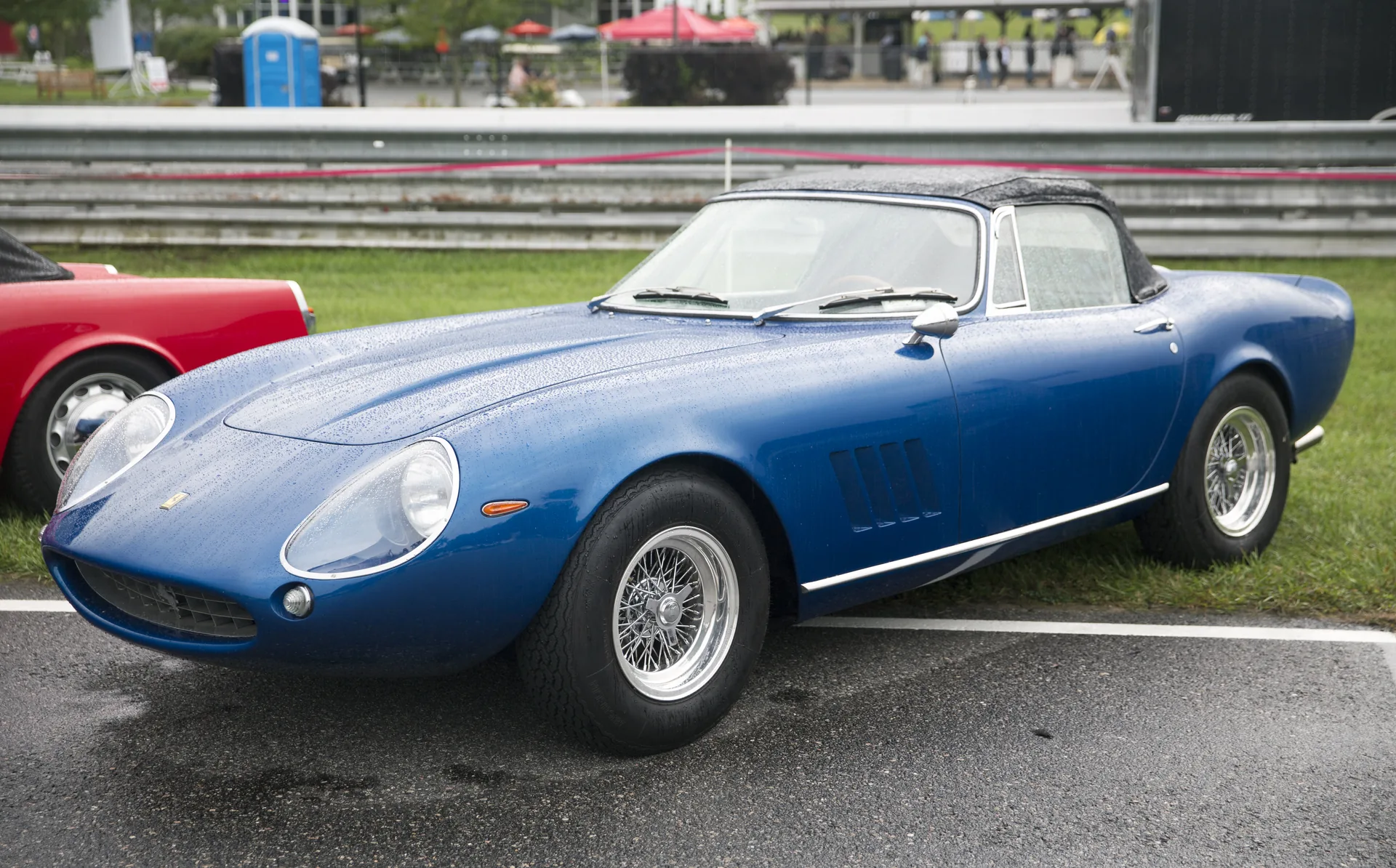
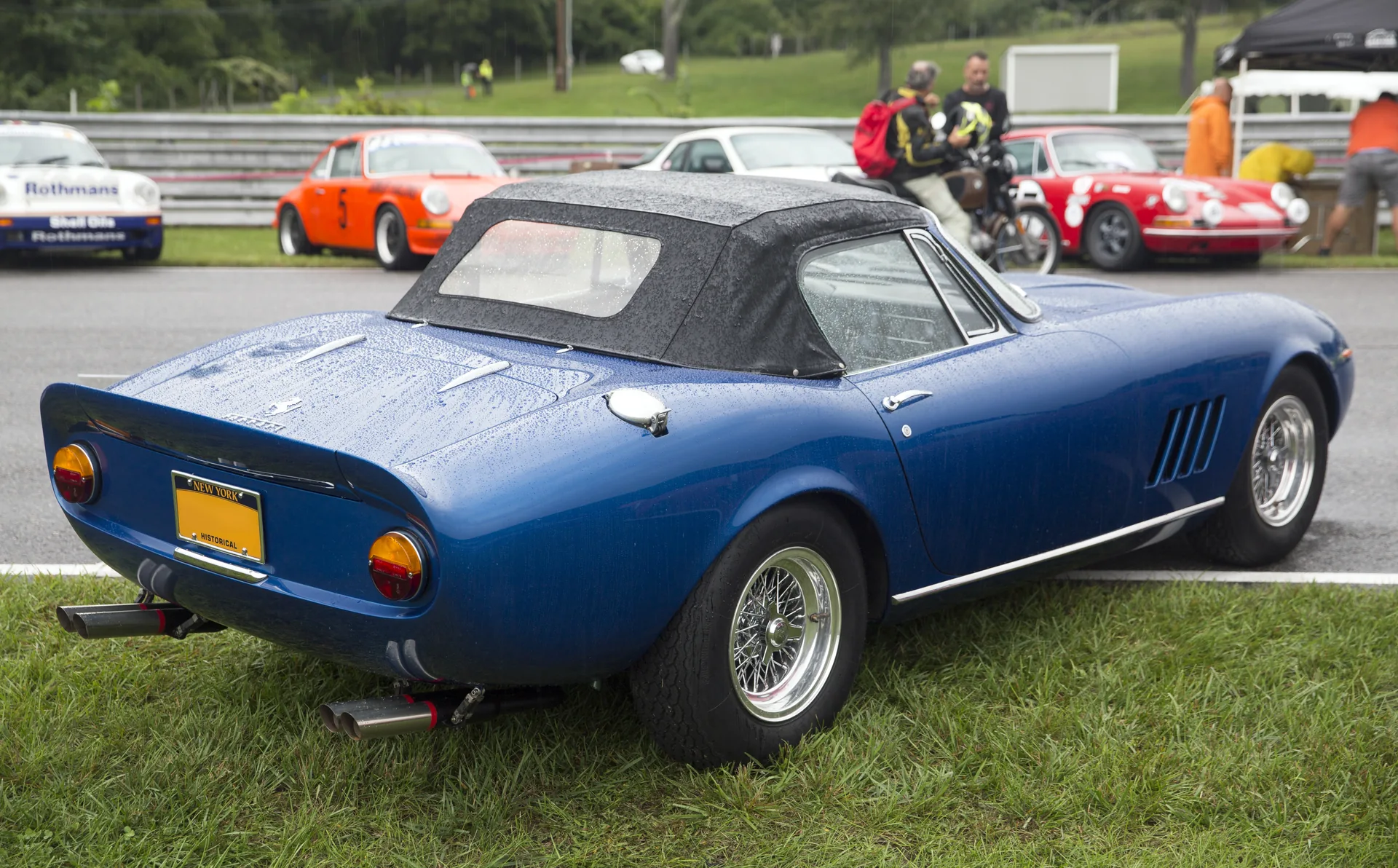
The catalogue cites copies of the factory build sheets and lists the car’s ownership and exhibition history. We do not reproduce the auction-house photographs; you will find those on the official lot page. The photographs of the car in this article are freely licensed images of chassis 10453, taken at the 2021 Lime Rock Historic Festival, not auction photography.
The story of chassis 10453
Why there are only ten
According to the catalogue, Luigi Chinetti urged the factory to authorize a small series of open cars based on the 275 GTB/4 berlinetta. They kept the berlinetta’s 3.3-liter four-cam V-12, five-speed transaxle, independent suspension and disc brakes, and wore a North American Racing Team badge on the tail panel. The first two were built in aluminum. The remaining eight, the catalogue says, began as completed steel-bodied berlinettas that Scaglietti then converted. All but one went new to the United States.
Ten cars, then. Chassis 10453 was the sixth.
Not the Thomas Crown car
One clarification belongs near the top of any story about a NART Spider. The best-known example is the first one built, chassis 09437. According to the catalogue, that car finished 2nd in class and 17th overall at the 1967 12 Hours of Sebring with Denise McCluggage and Marianne “Pinky” Windridge, appeared on the September 1967 cover of Road & Track, and was driven by Faye Dunaway’s character in the 1968 film The Thomas Crown Affair.
That is a different car. Chassis 10453 was not in the film. The catalogue’s account is that McQueen went on to acquire a NART Spider of his own, and this is it. The catalogue also states plainly that 10453 was neither a film prop nor a car repeatedly photographed for publicity.
New to McQueen
Chassis 10453 was completed in September 1967 and finished in Blu Sera, or Evening Blue (paint code 106-A-18), over black Connolly leather. Marcel Massini, quoted in the catalogue, records it as the first of just two NART Spiders so specified. It was invoiced to Luigi Chinetti Motors with a surcharge recording its conversion from berlinetta to Spider form, shipped from Italy that fall, sold to Steve McQueen through Hollywood Sport Cars, and flown to Los Angeles International Airport.
McQueen did not leave it as delivered. He had it repainted a darker metallic blue, had the seats retrimmed and made other cosmetic changes. The catalogue, drawing on recollections recorded by Matt Stone in McQueen’s Machines, adds detail: his friend R. Lee Brown collected the car from LAX; upholsterer Tony Nancy retrimmed the seats with a distinctive stitch pattern; and Brown removed the bumpers, fitted an external quick-fill fuel cap and a small rally-style mirror, and fabricated a radio console and a concealed power antenna.
The accident on Pacific Coast Highway
According to the catalogue, the car was in an accident on Pacific Coast Highway: it was struck from behind in traffic and pushed into the car ahead, which meant repairs at both ends. The work was done by Hershel “Junior” Conway of House of Color, who also painted the car. The “flip-tail” and flared fenders are, in the catalogue’s careful phrase, “generally attributed” to Conway’s work. The accident and the Conway repair are confirmed by the Gooding Christie’s press release and by Octane as well. Anyone weighing this car should treat that episode as part of its history, not a footnote.
Three owners and a long quiet
The catalogue lists the provenance as follows:
- Steve McQueen, Los Angeles (acquired new via Hollywood Sport Cars, 1967)
- J. David Kopf, Tujunga, California (acquired by 1971)
- Grand Prix SSR, Setauket, New York (acquired from the above, 1985)
- Current owner (acquired from the above, 1986)
Not counting the dealer, that is three private owners from new. The car has been in its current collection since 1986, close to four decades. It has been shown sparingly: the catalogue lists Le Cercle Concours d’Elegance at the Hollywood Bowl in 1971, the Louis Vuitton Classic at Rockefeller Center in New York in 1996, and La Bella Macchina: The Art of Ferrari at the Chrysler Museum of Art in Norfolk, Virginia, in 2003. The catalogue also mentions a 1971 photograph said to show California plate ZSW 815, a plate first issued in 1969.
The house describes the car as “seldom seen in public and never before offered at auction,” and Octane calls this its public auction debut.
What the catalogue documents, and what it doesn’t
The catalogue describes 10453 as “preserved rather than restored.” It states that the car retains its matching-numbers engine and transaxle, its original Scaglietti body, its distinctive metallic blue finish and its McQueen-era custom details. Gilded Lot has not inspected the car; these are the catalogue’s claims.
On the paperwork, the catalogue says copies of factory build sheets confirm Borrani wire wheels, Michelin tires and US instrumentation, and record engine internal no. 1836 and transaxle internal no. 535/I/R. Blu Sera is recorded as the original colour. The car was later refinished in a darker metallic blue, as described above.
The most useful passage is the one where the catalogue limits itself. It says the surviving record does not establish how often McQueen drove the car or exactly when it left his possession, and that no period photographs are known to show him with it. It also says the sale to McQueen when new is “beyond question.” That is a good model of honest provenance writing: firm where the documents are firm, and open about the gaps.
What provenance does to a price
A documented first owner, a production run of ten and a car that has stayed out of the saleroom help explain why an auction house would publish a high estimate. They do not decide the result. An estimate is the house’s published range; the hammer price is set on the day by whoever is bidding, and the final cost to a buyer is higher once premium and other charges are added. Our guide to how auction estimates and reserves work explains what that range does and does not mean.
Provenance also does not replace the mechanical and documentary facts. A famous name sits on top of a car that still has to be what the catalogue says it is. That is why claims such as “matching numbers” deserve close reading rather than assumption.
Classic car prices can fall as well as rise, and estimates can be missed as well as exceeded. Nothing here is investment or financial advice.
How to read a lot like this
Pin down the matching-numbers claim. Ask which components it covers (here, the catalogue names the engine and transaxle) and which documents support it. The build-sheet internal numbers quoted in the catalogue are the kind of evidence to compare against the car itself. Our guide to matching numbers on a classic car walks through what to ask.
Read the condition report, if the house provides one. A lot essay tells a story; a condition report should tell you about paint, bodywork, mechanical state and known repairs. With a recorded accident and later paintwork in this car’s history, that matters. See how to read an auction condition report.
Do the arithmetic on cost. The estimate is not what a buyer pays. Add the buyer’s premium and any taxes, fees, transport and insurance before comparing numbers.
See upcoming classic car sales in the auction calendar
If you want to bid
Bidding on a lot like this starts with registering with the auction house well before the sale, following its own terms and any deposit or financial checks it requires. The public preview at the Javits Center runs from Wednesday 18 through Saturday 21 November 2026, which is the chance to see the car in person. Our overview of how classic car auctions work and how to bid covers the process, and the general guide on how to bid at auction explains bidding methods.
Be clear on the difference between estimate, hammer price and the total including buyer’s premium. And plan for what follows a winning bid: payment deadlines, collection, shipping and, for buyers outside the United States, customs. Our guide to what happens after you win an auction sets out those steps.
Never miss a major sale. Get a short email when we update the auction calendar, usually once or twice a month, with the sales worth watching and the occasional new guide. Free, and you can unsubscribe with one click.
Important
This article is general information, not legal, financial or valuation advice. Catalogue estimates can be revised, and lots can be withdrawn before or during a sale. Facts about the car are reported as stated by the auction house and the sources below. Nothing on this page suggests that buying this car, or any classic car, will make anyone money.
Sources
- Christie’s, lot 33, sale 25352, Retromobile New York Auctions: 1967 Ferrari 275 GTB/4*S NART Spider, chassis 10453. https://www.christies.com/en/lot/lot-6612307. Accessed 14 November 2026.
- Gooding Christie’s, lot page: 1967 Ferrari 275 GTB/4*S NART Spider. https://www.goodingco.com/lot/1967-ferrari-275-gtb-4s-nart-spider. Accessed 14 November 2026.
- Gooding Christie’s, press release, 10 September 2026: Gooding Christie’s to auction Steve McQueen’s Ferrari 275 GTB/4*S NART Spider at inaugural New York sale. https://www.goodingco.com/press/article/gooding-christies-to-auction-steve-mcqueens-ferrari-275-gtb-4-s-nart-spider-at-inaugural-new-york-sale. Accessed 14 November 2026.
- Elliott Hughes, Octane, 11 September 2026 (independent report; photography credited to Gooding Christie’s). https://www.octane-magazine.com/news/steve-mcqueen-ferrari-275-gtb-4-nart/. Accessed 14 November 2026.
- Christie’s, editorial, 2 November 2026: “Steve McQueen’s Ferrari, Billy Joel’s motorcycles and more: inside Retromobile New York.” https://www.christies.com/en/stories/inside-gooding-christies-retromobile-2026-180544bf3d484d18a597d2733b685408. Accessed 14 November 2026.